North Augusta’s Fall Line Profile: Why Mixed Soil Creates Septic Complexity
The Fall Line is a geological feature running through Georgia and South Carolina where the ancient Piedmont plateau drops into the younger Coastal Plain. North Augusta sits directly on this boundary, creating a landscape where dense red Piedmont clay transitions abruptly into loose coastal sand—sometimes within 50 feet. For septic systems, this creates three persistent challenges:
- Unpredictable Drainage Patterns: A drainfield installed in clay soil drains slowly (60-120 minutes per inch percolation rate), risking hydraulic overload during wet seasons when effluent can’t absorb fast enough. A drainfield in sandy soil drains rapidly (20-40 minutes per inch), risking groundwater contamination because effluent bypasses biological filtration. Properties in North Augusta often have BOTH soil types in different sections of the yard, making standard drainfield design inadequate. Engineers must test multiple locations and design hybrid systems accounting for variability.
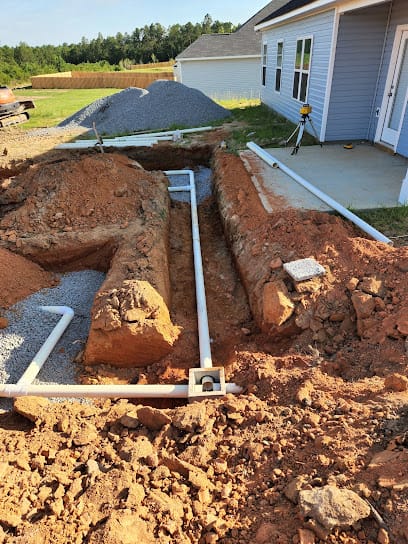
- Structural Instability in Sandy Sections: Coastal sand is loose and prone to shifting. Drainfield trenches excavated in sand require proper bedding (gravel, not native sand) and compaction to prevent settling. Without it, lateral pipes shift out of alignment, distribution boxes tilt, and effluent flows unevenly—causing some lines to fail while others remain dry. This is especially common in Clearwater and newer North Augusta subdivisions built on former agricultural land where topsoil was removed during grading.
- Clay Puddling and Surface Water Issues: In clay-heavy sections (common in Belvedere and older Aiken neighborhoods), rain saturates the soil quickly but drains slowly. Drainfields become waterlogged, preventing effluent absorption. Homeowners see standing water over the drainfield, sewage backing up into the house, or wet spots that persist for weeks. This isn’t always drainfield failure—sometimes it’s just clay soil doing what clay soil does during wet seasons.
If you’re in a newer North Augusta subdivision, your system likely has engineered plans accounting for soil variability. If you’re in an older Belvedere home or a rural Edgefield property, your system may have been installed before soil testing was standard—meaning it’s designed for “average” soil that doesn’t exist on the Fall Line.
Common Septic Issues in North Augusta & The CSRA
1. Fall Line Soil Variability: When Standard Systems Fail
The single biggest cause of septic problems in North Augusta is systems designed for uniform soil installed in variable terrain. A contractor digs one test hole, finds sandy soil, and designs a drainfield for rapid percolation. But 20 feet away, there’s a clay lens that retains water. Half the drainfield works perfectly; the other half stays saturated year-round. Effluent backs up, tanks fill faster than expected, and homeowners call for emergency pumping every 12-18 months.
Carolina Septic diagnoses this by performing dye tests (injecting colored dye into the tank and observing where it surfaces) and visual inspections of the yard during wet weather. If dye appears in clay sections but not sandy sections, it confirms uneven drainage. Fixes range from simple (redirecting household water use to reduce load) to complex (installing additional laterals in better-draining soil or converting to a low-pressure dosing system that distributes effluent evenly regardless of soil type).
2. Tree Root Intrusion: The CSRA’s Persistent Enemy
Aiken County is heavily wooded. Oak, pine, sweetgum, and pecan trees dominate residential properties, and their roots seek water aggressively. In sandy soil, roots penetrate drainfield laterals easily because joints and perforations aren’t sealed tightly. In clay soil, roots exploit any crack or opening to access moisture trapped in the drainfield. Once inside, roots form dense mats that block effluent flow entirely.
Homeowners notice recurring clogs in the same drain, toilets that gurgle when water runs elsewhere in the house, or sewage backing up after heavy rain (when roots swell with absorbed water). A camera inspection reveals root masses inside the tank’s outlet baffle or throughout lateral pipes. Hydro-jetting (high-pressure water cleaning at 3,000-4,000 PSI) clears roots temporarily, but they regrow within 6-18 months unless trees are removed or root barriers installed.
In North Augusta’s mature neighborhoods like Belvedere, where 50+ year-old trees surround older homes, root intrusion is nearly inevitable. Carolina Septic recommends preventive root treatment (copper sulfate flushes or foaming root killers) every 2-3 years for properties with trees within 50 feet of the drainfield.
3. Real Estate Inspections: Discovering Hidden Problems
Aiken County’s real estate market is active, with buyers from Georgia and other parts of South Carolina relocating to the CSRA. South Carolina requires septic inspections for property transfers, and Carolina Septic performs dozens monthly. Common findings include: tanks that haven’t been pumped in 5-10 years (sludge levels at 50-70% capacity), missing or damaged effluent filters, collapsed baffles, root-invaded laterals, and drainfields showing signs of surfacing effluent.
Inspections involve camera examination of the tank interior, measurement of sludge and scum layers, dye testing to verify drainfield function, and visual assessment of the yard for wet spots or odors. Written reports document system condition and recommend repairs. Common repair costs discovered during inspections: pump-out and filter cleaning ($300-$500), baffle replacement ($500-$800), single lateral replacement ($2,000-$4,000), full drainfield replacement ($8,000-$15,000).
Buyers use inspection reports to negotiate price reductions or demand sellers make repairs before closing. Sellers benefit from pre-listing inspections that identify problems early, allowing time for repairs without delaying sales.
4. Clay Puddling and Hydraulic Overload
In Belvedere and other clay-heavy sections of North Augusta, hydraulic overload during wet seasons is the norm, not the exception. Clay soil holds moisture like a sponge. When spring rains dump 3-4 inches in a week, the ground saturates completely. Drainfields have no absorption capacity—effluent backs up into tanks, then into houses. Toilets won’t flush. Drains gurgle. Homeowners see standing water over the drainfield.
This isn’t always system failure—it’s temporary saturation. Carolina Septic advises water conservation (shorter showers, fewer laundry loads, no dishwasher use) until the ground dries out. If puddling persists into dry summer months, the drainfield has likely failed due to biomat buildup and needs replacement. But if it clears up within 2-3 weeks of rain stopping, the system is functional—just challenged by clay soil’s poor drainage.
Long-term solutions include converting to mound systems (elevated drainfields above the clay layer) or drip distribution systems (shallow drip lines that function even in saturated soil). Cost is $12,000-$18,000, but it eliminates the annual wet-season backup cycle.
5. Sand Shifting and Drainfield Settling
In Clearwater’s newer subdivisions and sandy sections of North Augusta, drainfield settling is a common failure mode. Loose coastal sand doesn’t provide stable support for lateral pipes. Over 5-10 years, trenches settle, pipes sag, distribution boxes tilt, and effluent flows unevenly. Some laterals receive all the flow while others remain dry, causing premature biomat buildup in overloaded sections.
Symptoms include slow drains throughout the house, wet spots in only one section of the drainfield (not the entire area), or sewage surfacing at the toe of a slope. Excavation reveals tilted distribution boxes or sagging lateral pipes. Repairs require re-excavating trenches, installing proper gravel bedding, releveling distribution boxes, and replacing damaged pipes. Cost is $3,000-$6,000 for partial repairs, $8,000-$12,000 for full drainfield reconstruction.
6. Missing or Buried Access Points
Many older North Augusta properties have septic tanks buried with no surface access. Every pump-out or inspection requires digging to locate lids—adding $200-$400 to the cost and delaying service. This is especially problematic during emergencies when homeowners need same-day pumping to prevent sewage backup.
Carolina Septic installs risers (green or black plastic extensions) that bring tank lids to ground level. Cost is $300-$500 per lid, and it transforms future service from a 3-hour excavation job to a 45-minute pump-out. For properties with difficult access (tanks located in wooded areas, under decks, or on steep slopes), risers are essential for ongoing maintenance.
Complete Septic Maintenance for Aiken County
Our directory connects you with Carolina Septic because they provide straightforward, experienced wastewater services throughout the CSRA:
- Septic Tank Pumping: Routine maintenance for residential and commercial properties. Proper pump-outs remove all sludge and scum layers, clean effluent filters (if present), and inspect tank condition. In Fall Line terrain with mixed drainage, pumping frequency varies: every 2-3 years in clay-heavy areas with poor drainage, every 3-5 years in well-drained sandy areas. Cost is $300-$500 for standard 1,000-1,500 gallon tanks.
- System Repairs: Emergency and planned repairs for crushed laterals, collapsed baffles, root-invaded pipes, tilted distribution boxes, and cracked tanks. Camera inspections diagnose problems accurately, preventing unnecessary full replacements. Common repairs include lateral replacement ($2,000-$4,000), baffle repair ($500-$800), distribution box releveling ($800-$1,500), and tank crack sealing ($400-$700).
- Drainfield Restoration: When biomat buildup or structural failure occurs, Carolina Septic assesses whether restoration is possible or full replacement is needed. Minor issues (single failed lateral, tilted d-box) can be repaired for $2,000-$5,000. Major failures (entire field saturated, biomat irreversible) require full replacement at $8,000-$15,000 depending on soil conditions and system type required.
- Real Estate Septic Inspections: Required for property transfers in South Carolina, inspections include camera examination of tank interiors, sludge level measurement, dye testing for drainfield function, and visual yard assessment. Written reports document system condition and estimate repair costs. Pre-listing inspections help sellers address problems before marketing; buyer inspections inform negotiation and prevent post-closing surprises.
- Riser Installation: Retrofitting surface-level access lids eliminates excavation costs for future pump-outs and inspections. Professionals locate buried tanks (often requiring probing or excavation the first time), install 18-24 inch risers, and seal with locking lids. Cost is $300-$500 per lid. Essential for properties with difficult tank access or for homeowners planning long-term ownership.
- Effluent Filter Cleaning and Replacement: The effluent filter (the “kidney” of the septic system) traps solids before they enter the drainfield. In Fall Line terrain where soil variability accelerates biomat formation, clogged filters cause rapid backup. Filters should be cleaned every 6-12 months in high-use homes. If missing or damaged, new filters cost $200-$400 installed and prevent thousands in drainfield damage.
Why The CSRA Trusts Carolina Septic (3.9 Stars, 100+ Reviews)
Years of Local Experience: We’ve Seen It All: Carolina Septic has operated in the CSRA for years, pumping thousands of tanks across North Augusta, Aiken, Edgefield, and surrounding areas. This volume creates expertise that newer companies can’t match. They’ve encountered every soil combination the Fall Line produces, every tree species that invades laterals, and every vintage of septic system from 1960s clay tiles to modern aerobic units. When a problem arises, they diagnose it quickly because they’ve solved it before.
Hardworking and Busy: A Known Quantity: The 3.9-star rating with over 100 reviews reflects reality: Carolina Septic is a high-volume operation serving a large geographic area. They’re busy—which means occasional scheduling delays or communication gaps. But it also means they’re trusted by hundreds of CSRA homeowners who keep calling back. In a business where fly-by-night operators disappear after a few bad jobs, longevity and volume matter. You’re working with a known quantity, not an unknown risk.
Understanding Fall Line Geology: Generic septic advice doesn’t work on the Fall Line. You can’t follow standard “pump every 3 years” schedules when your drainfield is half clay (needs pumping every 2 years) and half sand (could go 5 years). You can’t use the same drainfield design for properties 200 feet apart when soil percolation rates vary by 400%. Carolina Septic adjusts its approach based on actual conditions at your property—not textbook assumptions.
Straightforward Service Without Overselling: Some septic companies push expensive replacements when repairs would suffice. Others recommend unnecessary upgrades or premium services. Carolina Septic takes a straightforward approach: they diagnose the problem, explain your options, and let you decide. If your tank just needs pumping, they’ll pump it. If your drainfield needs replacement, they’ll tell you that too—but they won’t upsell you into systems you don’t need.
Serving the Entire CSRA: From Gregory Lake Road in North Augusta, Carolina Septic serves a 30-mile radius covering Aiken County, Edgefield County, and parts of Georgia across the Savannah River. This regional coverage means contractors who understand the full spectrum of CSRA terrain—from downtown Aiken’s historic properties to rural Edgefield farmland to North Augusta’s Fall Line subdivisions. One company handles the entire region’s septic needs.
Ready for Experienced Septic Service in The CSRA?
Contact Carolina Septic at (803) 278-6748 or request service through our directory. Whether you’re facing routine pumping in North Augusta, emergency repairs in Belvedere, real estate inspections in Aiken, drainfield restoration in Clearwater, or riser installation in Edgefield, you’re connected with local contractors who understand Fall Line geology and have the volume of experience to handle any septic challenge.
Don’t gamble on inexperienced operators who’ve never worked in mixed clay-sand terrain. Don’t settle for generic advice that doesn’t account for the Fall Line’s unique challenges. Find hardworking professionals who know the CSRA ground because they’ve been digging in it for years—and who deliver straightforward service without overselling or over-promising.