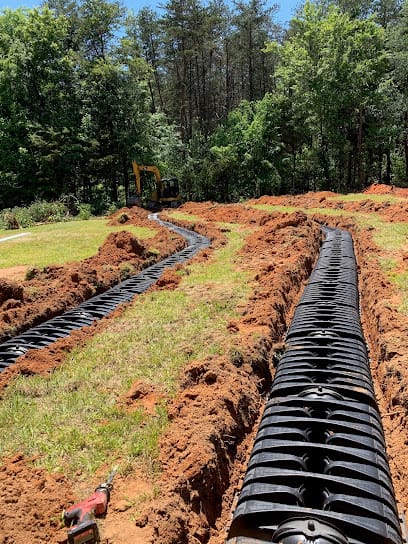
Mocksville's Soil Profile: Why Plastic Clay Changes Everything
Mocksville has a soil series named after it—rare recognition of the town's geological significance. Mocksville Series soils feature 12-18 inches of sandy loam topsoil overlying a distinctive "very sticky, very plastic" strong brown clay subsoil (Bt horizon starting at 18-24 inches depth). This plastic clay has moderate to high shrink-swell potential and restrictive percolation rates (60-120 minutes per inch)—slower than standard Piedmont red clay. The "sticky, plastic" descriptor isn't casual—it's official USDA soil taxonomy describing clay that adheres strongly to tools when wet and can be molded like modeling clay. This plasticity creates drainage problems during Davie County's wet seasons (November-April) when the clay absorbs water, swells, and restricts percolation. Add saprolite (multicolored decomposed rock appearing at 36-48 inches)—which may or may not be suitable for septic treatment depending on structure—and you're dealing with complex subsurface conditions requiring careful evaluation.
- Plastic Clay Restrictive Percolation = Seasonal Failures: Mocksville Series clay has "very sticky, very plastic" characteristics that restrict water movement. During wet seasons, the clay absorbs moisture, swells, and percolation rates drop significantly. Drainfields that work adequately during summer dry seasons (when clay dries and cracks slightly) slow or stop during winter/spring wet periods. This creates seasonal system performance—fast drains in summer, slow/backing drains in winter. The plastic clay doesn't drain fast enough to handle effluent volumes during prolonged wet weather. Systems require oversizing (larger drainfield areas) or pressure distribution (forcing percolation through resistant clay) to work year-round.
- Kinderton Village High-Density Development = Hydraulic Overload: Eastern Davie County's rapid growth pushed high-density development onto marginal soils. Kinderton Village exemplifies this—a master-planned community with 0.5-0.75 acre lots on eroded Mocksville Series clay. Soil erosion from development removed the sandy topsoil, leaving shallow clay subsoil exposed. These lots are too small for conventional systems sized for plastic clay percolation rates. Standard designs work initially but fail within 5-10 years as clay seals from biomat acceleration in restrictive soil. This isn't poor construction—it's undersized systems on marginal soils. Proper design requires 150-200% larger drainfields or advanced treatment technologies.
- Saprolite Treatment Zone Uncertainty: Saprolite—decomposed granite, gneiss, or schist retaining rock structure but weathered to soil-like texture—appears throughout Mocksville at 36-48 inches depth. It displays distinctive multicolored mottling (reds, yellows, grays) and may look like solid rock or crumbly soil depending on decomposition stage. Some saprolite has fractured structure allowing adequate percolation for septic treatment. Other saprolite is massive (solid structure) and doesn't percolate at all. Only deep pit testing (excavating to 48+ inches, observing structure, conducting texture and percolation tests) reveals whether saprolite can be used. Systems installed assuming permeable saprolite but encountering impermeable zones fail catastrophically.
Common Septic Issues in Mocksville
1. Kinderton Village Hydraulic Overload (High-Density Development)
This is eastern Davie County's defining septic problem. Kinderton Village's master-planned density brought suburban-scale development (0.5-0.75 acre lots) to marginal Piedmont clay soils. Your system worked fine initially—fast drains, no problems. Within 5-10 years, it starts showing stress. Drains slow after heavy water use (multiple showers, laundry day). During wet seasons, it backs up completely. By year 10-15, you're experiencing chronic failures requiring frequent pumping. This is hydraulic overload—the drainfield is too small for plastic clay percolation rates on small lots. Symptoms include systems that worked initially but degrade over time, recurring backups during wet seasons or heavy use, wet spots appearing in yard after laundry/guests, and complete failure within 10-15 years requiring replacement. The original designs were undersized for Mocksville Series clay behavior. Standard calculations assume moderate Piedmont clay percolation (45-90 minutes per inch). Mocksville plastic clay percolates at 60-120 minutes per inch—requiring 30-50% larger drainfields. On small lots with limited space, conventional sizing doesn't work. Solutions require oversized drainfields (150-200% conventional sizing to accommodate plastic clay), Low-Pressure Pipe (LPP) systems (using pressure distribution to maximize treatment in limited space), Aerobic Treatment Units (ATUs) (providing secondary treatment, reducing drainfield size requirements 30-40%), or pressure-dosed systems (forcing effluent through resistant clay in timed doses). Contractors in our directory understand Kinderton's density challenges and design systems sized for actual plastic clay performance—not code minimums that fail in restrictive soils.
2. Mocksville Series Plastic Clay Seasonal Failures
If you live anywhere in Davie County on Mocksville Series soils, your system likely shows seasonal performance variation. It works well June through October—fast drains, no issues. Then November through April (wet season), problems appear. Drains slow during rain. Toilets gurgle after prolonged wet weather. Wet spots develop over the drainfield during wet months. Come June, everything works perfectly again. This cycle repeats annually. This is plastic clay seasonal restriction—the "very sticky, very plastic" Mocksville clay absorbs water during wet seasons, swells, and percolation rates drop. Drainfields sized for moderate percolation can't handle reduced rates during saturation. Symptoms include perfect dry-season performance / wet-season failures, recurring slow drains November-April, wet spots appearing during prolonged rain, and complete resolution when dry weather returns. This isn't system failure—it's seasonal clay behavior. Pumping the tank helps temporarily but doesn't address soil restriction. Solutions include oversized drainfields (30-50% larger than standard to accommodate seasonal rate drops), pressure distribution (dosing effluent in controlled pulses, allowing clay recovery between applications), curtain drains (intercepting surface water upslope, reducing clay saturation), or mound systems (elevating drainfields above seasonally saturated plastic clay). Contractors in our network design for worst-case wet-season percolation rates—not dry-season ideal conditions that don't represent annual reality.
3. Saprolite Treatment Zone Failures (Uncertain Decomposed Rock)
Mocksville properties frequently encounter saprolite—multicolored decomposed rock—at 36-48 inches depth. This weathered bedrock looks like solid rock, crumbly soil, or something in between depending on decomposition stage. Some saprolite has fractured structure (rock that decomposed along fracture planes, creating permeable pathways). Other saprolite is massive (decomposed uniformly into dense material with no fractures, effectively impermeable). Standard 30-inch test pits don't reach saprolite depth, so perc tests sample only the overlying plastic clay. Systems get designed and permitted based on clay performance. Then installation hits saprolite at 36-48 inches—and no one knows if it will work. Symptoms include systems that pass perc tests but fail within 1-3 years of installation (saprolite turned out to be impermeable), drainfields that work during dry years but flood during wet years (saprolite has limited storage capacity), and catastrophic failures requiring complete replacement (massive saprolite can't be used). Prevention requires deep pit testing—excavating test pits to 48-60 inches depth, exposing saprolite, observing structure (fractured vs. massive), conducting texture tests (how much it crumbles), and performing deep percolation tests at installation depth. If saprolite is permeable, it can be used for treatment (often better than overlying clay). If massive/impermeable, systems must be installed entirely above saprolite or relocated. Contractors in our directory perform deep evaluations as standard practice in Mocksville—preventing catastrophic failures from unexpected impermeable saprolite.
4. Yadkin River Watershed Nutrient Management Requirements
Properties within the Yadkin River watershed (most of Mocksville) or near the river itself face nutrient management requirements protecting this major water source. The Yadkin supplies drinking water to downstream communities and supports recreation. Failing septic systems directly threaten water quality. During repairs, renovations, or real estate transactions, watershed properties trigger mandatory system upgrades. Symptoms include permit denials (existing conventional systems don't meet Yadkin watershed standards), inability to repair in place (must upgrade to advanced treatment), real estate delays (buyers discovering watershed non-compliance), and county enforcement requiring system replacement. Solutions include advanced pretreatment systems (Type II or Type III reducing nitrogen/phosphorus before drainfield), Aerobic Treatment Units (ATUs) (providing secondary treatment, reducing nutrient loading), sand filters (tertiary treatment for critical areas), or drip irrigation systems (distributing effluent slowly for enhanced soil treatment). Davie County Environmental Health requires larger setbacks (100 feet vs. 50 feet standard) from perennial streams and prohibits repairs within floodplains without engineering. Contractors in our directory navigate Yadkin watershed permits and design compliant systems protecting water quality while serving homeowner needs.
Complete Septic Solutions for Mocksville Homeowners
- Septic Tank Pumping & Plastic Clay Performance Monitoring: In Mocksville Series plastic clay, contractors in our directory pump tanks every 3 years for standard households (every 2 years for Kinderton Village small-lot properties showing stress). They monitor seasonal performance patterns (noting summer vs. winter drainage), inspect for signs of clay restriction (slow tank drawdown after pumping), and properly dispose of waste at licensed facilities. Seasonal monitoring identifies plastic clay failures early.
- Kinderton Village Oversized System Design: For high-density development properties on marginal eroded clay, contractors in our network design oversized drainfields—installing 150-200% more lateral length than conventional calculations indicate. They use pressure distribution manifolds (dosing effluent evenly across extended fields), install observation ports (monitoring system performance), and design for plastic clay's restrictive percolation. These systems work long-term on small lots where conventional designs fail within 10 years.
- Low-Pressure Pipe (LPP) Systems for Small Lots: When lot size limits drainfield expansion, LPP systems maximize treatment in available space. These use pumps to distribute effluent through smaller diameter laterals in timed doses, pressure-compensating orifices ensuring equal distribution, and dosing schedules allowing soil recovery between applications. Our network designs LPP systems specifically for Kinderton Village and similar high-density areas, achieving adequate treatment on 0.5-0.75 acre lots in plastic clay.
- Plastic Clay Seasonal Performance Solutions: For properties experiencing wet-season failures from Mocksville Series clay restriction, contractors in our directory design oversized drainfields (30-50% larger than standard to accommodate seasonal rate drops), pressure distribution (forcing percolation through saturated clay), curtain drains (intercepting upslope water reducing clay saturation), or mound systems (elevating above seasonally saturated zones). These systems work year-round—not just during dry seasons.
- Deep Saprolite Evaluation & Treatment Zone Design: Standard perc tests don't reveal saprolite behavior at 36-48 inches. Contractors in our network perform deep pit testing—excavating to 48-60 inches, exposing saprolite, observing structure (fractured vs. massive), conducting texture tests (crumble vs. solid), and performing percolation tests at actual installation depth. If saprolite is permeable (fractured), they design systems using it for treatment (often better than plastic clay). If impermeable (massive), they design shallow systems entirely above saprolite or relocate to better areas. This prevents failures from unexpected impermeable zones.
- Yadkin River Watershed Nutrient Compliance: For properties in Yadkin watershed, contractors in our directory install advanced pretreatment (Type II/III systems), ATUs (aerobic treatment reducing nitrogen), sand filters (tertiary treatment), or drip irrigation (enhanced soil treatment). They handle permitting with Davie County Environmental Health, coordinate watershed inspections, design systems meeting 100-foot stream setbacks, and ensure compliance protecting Yadkin water quality.
- Pressure Distribution for Restrictive Clay: Pressure-dosed systems maximize performance in Mocksville's plastic clay by distributing effluent in timed pulses across drainfields, allowing clay brief recovery periods between doses. Our network designs manifolds with pressure-compensating orifices (ensuring equal distribution despite clay resistance), installs dosing timers (optimizing clay treatment capacity), and provides pump maintenance. These work better than gravity systems in "very sticky, very plastic" Mocksville clay.
- Advanced Treatment for Density & Watershed: Aerobic Treatment Units (ATUs) solve multiple Mocksville challenges—reducing drainfield size for small Kinderton lots (30-40% smaller fields), improving effluent quality for Yadkin watershed protection (50-70% nitrogen reduction), and providing better treatment in restrictive plastic clay. Contractors in our directory install NSF-certified ATUs, design compliant drainfields, connect alarm systems, and provide mandatory annual maintenance required by Davie County permits.
- Real Estate Transfer Inspections (Davie County): Davie County requires septic inspections for property sales. Inspectors evaluate tank condition, test drainfield absorption in plastic clay, assess seasonal performance evidence, verify saprolite depth and suitability, check Yadkin watershed compliance, and identify undersized Kinderton Village systems. Mocksville properties often reveal plastic clay restriction, inadequate system sizing for density, or watershed non-compliance. Our directory connects you with certified inspectors familiar with Mocksville Series challenges and contractors for compliant replacements.
- Emergency Plastic Clay Failure Response: When your Mocksville system experiences failure from plastic clay restriction or hydraulic overload, you need specialists who understand Davie County soil behavior. Our network includes contractors available 24/7 who pump tanks for immediate relief, assess whether failure is temporary (seasonal clay saturation) or permanent (undersized design), provide emergency repairs preventing contamination, and design permanent solutions for plastic clay and density constraints. They understand this isn't a simple clog—it's soil mechanics and hydraulic loading requiring proper engineering.