Thomasville's Soil Profile: Why "Plastic Clay" Changes Everything
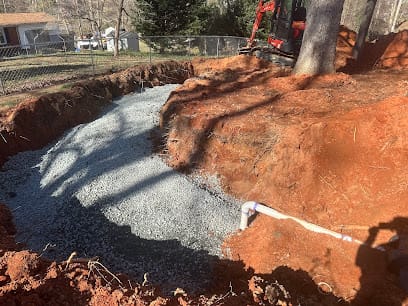
Thomasville sits on the Inner Piedmont where ancient metamorphic rocks weathered into some of North Carolina's most challenging septic soils. The Enon and Mecklenburg series—collectively called "plastic clay" because they behave like modeling clay when wet—dominate Davidson County and create septic system problems found in few other regions.
- Enon Series (The Yellow Plastic Clay): This distinctive yellow-orange clay forms from weathered diorite and gabbro—dark igneous rocks rich in iron and magnesium. The resulting clay has 40-60% clay mineral content with extreme plasticity: when wet, it becomes sticky and moldable like Plasticine; when dry, it hardens like concrete and develops deep shrinkage cracks. Percolation rates are extremely slow—90-180 minutes per inch, meaning water takes 2-3 hours to move just one inch through the soil. This creates immediate problems for drainfields: effluent has nowhere to go, biomat layers thicken rapidly because water movement is so restricted, and systems clog within 10-15 years instead of the 25-40 years typical in better-draining soils.
- Mecklenburg Series (The Red Plastic Clay): Similar chemistry to Enon but with higher iron oxide content giving it a redder color. It shares Enon's plasticity and slow percolation (90-150 minutes/inch) and causes identical septic challenges. The key distinction: Mecklenburg tends to occur on slightly better-drained slopes while Enon dominates flatter terrain, but both require specialized installation techniques and aggressive maintenance to function long-term.
- Shrink-Swell Destruction: Plastic clay expands 10-15% when saturated and contracts equally when dry, creating seasonal cycles that physically damage septic infrastructure. Tank lids crack and separate as soil swells against them. Pipe connections shear when clay expansion exceeds joint flexibility. Distribution boxes tilt and separate from lateral lines. Most insidiously, the expansion-contraction cycle pumps water into and out of tiny soil pores, accelerating biomat growth by constantly exposing soil bacteria to fresh nutrient-rich effluent. Contractors in Thomasville design systems with flexible connections, reinforced tank installations, and oversized drainfields to compensate for these destructive forces.
- Biomat Acceleration: The biomat—a biological slime layer that forms where effluent contacts soil—is normal and necessary for wastewater treatment. But in Enon/Mecklenburg plastic clay, biomat growth is pathological. The extremely slow water movement (90-180 min/inch) means effluent stays in contact with soil bacteria 3-6 times longer than in sandy or loamy soils. This extended contact time allows biomat to thicken from the normal 1-2mm to 5-10mm within 5-10 years. At these thicknesses, biomat becomes impermeable, sealing off the drainfield entirely. Systems fail—standing water appears, sewage backs up—and homeowners face replacement costs. Soil fracturing (Terralift) can extend life by 5-10 years by physically breaking up the biomat and creating new infiltration pathways.
Common Septic Issues in Thomasville
1. Premature Biomat Failure: The 15-Year Cliff
This is Thomasville's defining septic pattern. A system installed in Enon plastic clay works perfectly for 10-15 years. Then performance degrades rapidly: drains slow down, soggy spots appear over the drainfield during rain, sewage odors develop, and within 12-24 months the system fails completely. What happened? Biomat clogging reached critical mass. The biological slime layer that naturally forms at the soil interface thickened from 1-2mm (normal) to 8-12mm (impermeable) due to Enon's extremely slow percolation. Once biomat seals the soil pores, water physically cannot infiltrate and the field saturates. Before replacing the entire drainfield ($15,000-$25,000), contractors in our network offer Terralift soil fracturing—a process using compressed air to fracture the clay and break up biomat layers, restoring infiltration capacity for 5-10 years at a cost of $2,500-$4,500. This interim solution often extends system life long enough to save for eventual replacement.
2. Mill Village Straight Pipe Discoveries: The 90-Day Shock
Thomasville's mill villages—neighborhoods built by furniture companies in the 1920s-1940s to house factory workers—contain hundreds of homes with illegal infrastructure. Many still have straight pipes—sewage flows from the house directly into storm drains, ditches, or concrete-lined pits (cesspools) without any treatment. These systems predate modern septic codes and were considered acceptable in the pre-environmental era. Davidson County Environmental Health now identifies them through systematic surveys, property transfer inspections, and neighbor complaints. When discovered, owners receive 90-day compliance orders: install a modern septic system or face $500/day fines. The challenge: mill village lots are typically 50x100 feet—barely adequate for a house, let alone a modern drainfield. Solutions require aerobic treatment units that reduce required field size through enhanced pre-treatment ($12,000-$18,000), or negotiating off-site easements with neighbors ($15,000-$25,000 including legal costs). The financial shock devastates working-class homeowners who bought affordable historic properties without knowing about hidden infrastructure liabilities.
3. Shrink-Swell Infrastructure Damage: The Seasonal Destruction
Enon and Mecklenburg plastic clay undergoes extreme volume changes—expanding 10-15% when wet (winter/spring) and contracting equally when dry (summer/fall). This creates powerful forces that physically destroy septic infrastructure. Tank lids crack as expanding clay crushes them. Pipe joints separate when clay expansion exceeds connection flexibility. Distribution boxes tilt 3-5 degrees, causing uneven flow distribution that concentrates effluent in some laterals while starving others. Worst of all, the expansion-contraction cycle pumps groundwater into and out of soil pores, accelerating biomat formation by constantly exposing bacteria to fresh nutrients. Symptoms appear gradually: drains that work fine in summer but slow down in winter (when clay expands and squeezes the drainfield), cracked tank lids discovered during pumping, or sewage surfacing in random locations where pipes have separated. Repairs require: replacing rigid connections with flexible couplings ($1,500-$3,000), reinstalling tanks with expansion-resistant backfill materials ($4,000-$7,000), or complete system replacement if structural damage is severe ($18,000-$28,000).
4. Hydraulic Overload in Dense Clay: When Slow Percolation Meets Modern Appliances
Thomasville's plastic clay drains so slowly (90-180 min/inch) that drainfields sized for 1980s-1990s water usage patterns cannot handle modern appliance loads. High-efficiency washing machines, multiple daily showers, and dishwashers generate 300-400 gallons/day per household—50% more than systems were designed to handle when installed 20-30 years ago. The slow percolation can't keep up: hydraulic overload saturates the field even though it's technically the "right size" according to original permits. You see standing water over the drainfield year-round, sewage backing up during peak usage (laundry day, multiple showers), and constant foul odors. Solutions: (1) reduce water usage through low-flow fixtures and laundry timing ($0 cost but lifestyle impact), (2) expand the drainfield by 40-60% to match actual loads ($8,000-$15,000), or (3) install aerobic treatment units that reduce required field size while handling higher loads ($12,000-$18,000).
5. I-85 Industrial Development Soil Compaction
Thomasville's Business 85 corridor is experiencing industrial expansion—warehouses, logistics centers, and manufacturing facilities. Heavy construction equipment compacts Enon clay on adjacent residential properties, destroying its already-limited percolation capacity. Plastic clay is especially vulnerable to compaction: heavy equipment crushes pore spaces that took centuries to develop, reducing percolation rates from 90 min/inch (marginal) to 180+ min/inch (non-functional). Homeowners with previously functional systems suddenly see drainfield saturation, sewage backups, and complete system failure. The only fixes: (1) excavate and replace all compacted soil ($10,000-$18,000 for 400-600 sq ft drainfields), or (2) install above-ground spray irrigation systems that bypass the compacted layer ($18,000-$28,000). Before adjacent construction begins, contractors in our network document baseline system performance for potential property damage claims.
Complete Septic Solutions for Thomasville Homeowners
- Septic Tank Pumping & Sludge Removal: Thomasville's plastic clay and rapid biomat formation require aggressive pumping schedules. Professionals in our directory recommend every 2-3 years for standard households (versus 3-5 years in better soils) because the slow percolation causes solids to build up faster—they can't escape into the drainfield like in sandy soils. Proper pumping removes both sludge (bottom) and scum (top) layers. Some budget operators only pump the liquid middle, leaving you vulnerable to solids overflow that accelerates biomat clogging in already-challenged clay.
- Terralift Soil Fracturing for Biomat Restoration: When drainfields show signs of biomat clogging (slow drains, soggy spots, early failure after 10-15 years), Terralift soil fracturing offers a $2,500-$4,500 alternative to full replacement ($15,000-$25,000). This process uses a specialized probe driven 4-6 feet into the drainfield, then injects compressed air at 1,200 PSI to physically fracture the clay and break up biomat layers. The fracturing creates new infiltration pathways and restores percolation capacity. Results last 5-10 years, giving homeowners time to save for eventual replacement while maintaining system function. Essential for Thomasville properties where premature biomat failure is predictable in plastic clay.
- Mill Village Straight Pipe Replacement: When Davidson County identifies illegal straight pipes or cesspools, contractors design compliant systems for undersized mill village lots (typically 50x100 feet). Solutions include: (1) aerobic treatment units (ATUs) that reduce required drainfield size by 40-50% through enhanced pre-treatment ($12,000-$18,000 complete system), (2) drip irrigation systems that distribute effluent across minimal space ($14,000-$20,000), or (3) off-site easements with neighbors for additional drainfield area ($15,000-$25,000 including legal costs). Contractors coordinate permitting, manage 90-day compliance deadlines, and navigate Davidson County's abatement enforcement procedures.
- Plastic Clay New Installation Design: For new construction or replacements in Enon/Mecklenburg clay, contractors use specialized techniques to resist premature failure: (1) oversized drainfields—40-60% larger than code minimum to compensate for slow percolation and future biomat buildup, (2) flexible pipe connections—rubber couplings that accommodate shrink-swell movement without breaking, (3) reinforced tank installation—controlled density fill around tanks to resist clay expansion forces, and (4) pressure distribution—dosing pumps that distribute effluent evenly, preventing concentration that accelerates biomat formation. Additional cost: $3,000-$6,000 versus standard installations, but extends system life from 15 years to 25+ years in plastic clay.
- Shrink-Swell Damage Repair: When seasonal expansion-contraction cycles damage infrastructure, contractors offer targeted repairs: (1) flexible coupling retrofits—replacing rigid pipe connections with expansion-tolerant rubber joints ($1,500-$3,000), (2) tank reinstallation with proper backfill—removing tanks and reinstalling with gravel envelopes that resist clay pressure ($4,000-$7,000), or (3) distribution box leveling and reconnection—adjusting tilted D-boxes and re-establishing proper flow distribution ($2,000-$4,000). These targeted repairs prevent full system replacement when structural damage is caught early.
- Aerobic Treatment Units for Dense Clay: When conventional drainfields cannot provide adequate treatment time in slow-percolating plastic clay, ATUs (aerobic treatment units) offer enhanced pre-treatment that allows smaller drainfields while improving effluent quality. These "mini wastewater plants" use oxygen injection and biological processes to reduce BOD (biological oxygen demand) by 85-95% versus 40-60% in conventional tanks. Davidson County approves 40-50% drainfield reduction with certified ATUs. System costs $12,000-$18,000 installed (ATU plus reduced-size drainfield) with ongoing maintenance ($300-$450/year for blower service, media replacement, effluent testing). Essential for undersized lots where conventional expansion is impossible.
- Compaction Remediation for Construction Damage: When adjacent industrial development compacts plastic clay on residential properties, contractors offer: (1) deep excavation and soil replacement—removing compacted zones (typically 3-4 feet deep across 400-600 sq ft) and backfilling with loose, suitable topsoil ($10,000-$18,000), or (2) spray irrigation conversion—installing above-ground pressurized distribution that bypasses compacted layers ($18,000-$28,000). Before remediation, contractors document pre-construction system performance with photographs, pump-out records, and water table measurements for potential property damage litigation.
- Hydraulic Load Reduction Strategies: For systems experiencing hydraulic overload from modern appliance water usage, contractors implement: (1) low-flow fixture retrofits—replacing toilets (1.6 to 1.28 gallons/flush), showerheads (2.5 to 1.5 GPM), and faucet aerators, reducing household water usage 25-35% ($400-$800), (2) greywater diversion systems—routing washing machine discharge away from the septic system to irrigation zones ($1,500-$3,000), or (3) dual-field alternating systems—splitting the drainfield into two sections that alternate monthly, allowing each to rest and recover between uses ($6,000-$10,000 added cost). These strategies extend system life without full replacement.
- Effluent Filter Upgrades: The effluent filter is critical in plastic clay—it's the only defense preventing solids from reaching the drainfield where they immediately accelerate biomat formation in the slow-draining soil. Thomasville systems require filters with finer screening (1/16 inch versus standard 1/8 inch) and more frequent cleaning (every 4-6 months versus annually). Contractors in our network retrofit older tanks with high-capacity cartridge filters designed for challenging soils, extending drainfield life by years and preventing premature clogging that triggers expensive replacements.
- Pre-Purchase Plastic Clay Assessments: Before buying Thomasville property, contractors perform plastic clay septic evaluations—examining system age, drainfield size relative to house occupancy, signs of biomat clogging, and structural damage from shrink-swell cycles. Assessment costs $300-$500 and identifies: (1) systems nearing end-of-life (10-15 years old in plastic clay), (2) undersized fields that will fail under modern loads, (3) mill village properties with potential straight pipe liabilities. This prevents $15,000-$25,000 surprise replacements shortly after purchase.
- Riser Installation for Deep Burial: Thomasville's plastic clay often requires deep tank burial (4-5 feet) to reach bearing capacity that resists shrink-swell movement. Installing risers (plastic access lids extending to grade level) eliminates the $500-$800 excavation cost every time you need pumping or inspection. Risers retrofit for $600-$1,000 and protect landscaping from repeated disturbance. Essential in mill village historic districts where mature yards and established landscapes are key property values.