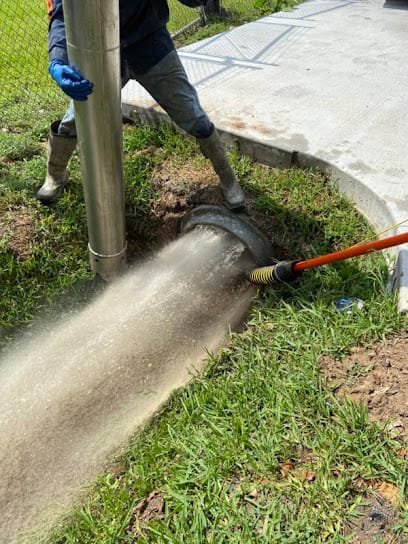
Anderson's Soil Profile: Why Cecil Red Clay Changes Everything
Anderson sits in the heart of the South Carolina Piedmont where Cecil red clay series dominates the landscape. This heavy, red sandy clay loam is legendary for its fertility—it built the Upstate's textile economy by producing the cotton that fed the mills. But that same tight clay structure creates percolation rates of 60-120 minutes per inch, requiring drainfield trenches 50-75% longer than systems in sandy Coastal Plain soils that percolate in 15-30 minutes per inch. What works in Columbia or Charleston fails in Anderson County without significant oversizing and engineered design.
- The Slow Percolation Problem: Cecil clay's molecular structure binds water tightly, creating exceptional nutrient filtration (good for wastewater treatment) but extremely slow drainage. A 3-bedroom home that needs 120 linear feet of drainfield trenches in sandy soil requires 180-200 feet in Cecil clay. Many contractors unfamiliar with Piedmont conditions size systems using statewide average calculations, leading to hydraulic overload and system failure within 3-5 years as effluent backs up faster than the clay can absorb it. Properly designed systems account for Cecil's characteristics from initial site evaluation, not after installation failure.
- Lake Hartwell Corps Line Constraints: The US Army Corps of Engineers owns all land below 660-foot elevation around Lake Hartwell—marked as the "Red Line" on USACE maps and survey plats. This federal jurisdiction extends 50-150 feet inland from the shoreline depending on lot topography. Septic system components (tank, drainfield, reserve area) cannot be installed on Corps property under any circumstances. Violations result in immediate removal orders, restoration requirements, and federal fines up to $25,000. For lakefront lots, this typically eliminates the entire back half of the property for septic use, forcing systems into front yards between the house and road—requiring pump stations to push wastewater uphill away from the lake.
- Pump System Requirements: Lake Hartwell properties slope down to the water, creating natural drainage toward the lake. To comply with USACE restrictions and SC DHEC setback requirements (100 feet from high-water mark), drainfields must be installed uphill from the house in front yard areas. This requires pump systems: a separate pump tank after the main septic tank, electrical service and controls, backup alarm systems, and pressurized distribution to force effluent uphill 15-40 vertical feet. Pump systems add $8,000-$12,000 to base installation costs and require annual maintenance ($200-$400) to prevent motor burnout and hydraulic failure. Many lakefront buyers don't budget for these costs until after closing when applying for septic permits.
- Mill Hill Legacy Infrastructure: Textile mill neighborhoods like Homeland Park, Equinox, and Orr were built between 1900-1940 for mill workers on tiny lots (50x100 feet typical). Original septic systems used clay tile pipes laid in shallow trenches—adequate for 1920s loading rates but failing catastrophically under modern water usage (showers, dishwashers, washing machines). These neighborhoods face unique challenges: lot sizes too small for modern drainfield sizing requirements (200+ linear feet won't fit on 50-foot lot widths), encroachment issues where neighbors' drainfields overlap property lines, and shared systems where 2-4 houses connect to common tanks that no longer meet capacity requirements. Replacement often requires variance applications, engineered alternative systems, or lot consolidation through purchase of adjacent properties.
Common Septic Issues in Anderson
1. Cecil Clay Hydraulic Overload: The Undersizing Problem
Hydraulic overload in Cecil clay occurs when drainfield trenches are sized using generic state formulas rather than soil-specific calculations. SC DHEC's standard sizing table assumes moderate percolation rates (45-60 minutes per inch), but Cecil clay commonly tests at 90-120 minutes per inch—double the standard rate. A 3-bedroom home that "should" need 120 linear feet according to state tables actually needs 180-200 feet in Anderson's Cecil clay. Symptoms appear within 2-4 years: slow drains during wet weather (November-March), sewage odors near the drainfield as effluent surfaces when soil can't absorb the volume, and eventually raw sewage backup into the house as the system's hydraulic capacity is exceeded. Early warning signs include soggy areas in the yard that stay wet for days after rain, grass that's suspiciously lush and green over the drainfield year-round (indicating continuous moisture and nutrient exposure), and gurgling sounds from drains as air displaces water backing up from saturated laterals. The fix requires complete drainfield replacement with proper sizing—typically 50-75% larger than the failed system—at costs of $12,000-$18,000. Contractors experienced with Cecil clay conduct actual perc tests at multiple depths rather than relying on generic tables, ensuring systems are sized for Anderson's real soil conditions from initial installation.
2. Lake Hartwell Corps Line Encroachment: The Federal Violation
Lakefront property owners face a unique regulatory trap: US Army Corps of Engineers federal jurisdiction over all land below the 660-foot elevation contour (the "Red Line"). Many older lakefront homes—particularly those built before 1980—have septic systems installed partially or entirely below this line when regulations were less strictly enforced. These systems are now in technical violation of federal law and face removal orders when discovered during property transfers, permit applications for additions, or complaints from neighbors. USACE enforcement has intensified since 2015 with aerial photography surveys and database cross-referencing of septic permits against Corps jurisdictional maps. Homeowners receive certified letters demanding immediate removal and site restoration within 90 days, with daily fines of $100-$500 for non-compliance. Replacement systems must be installed entirely above the Corps Line, typically in front yards, requiring pump stations to push wastewater uphill away from the lake. Total cost runs $15,000-$25,000 including tank relocation, pump system installation, uphill drainfield trenching, and electrical service. Many lakefront property sales fall through when title searches reveal existing Corps Line violations and buyers refuse to assume the liability. Contractors in our directory provide pre-purchase Corps Line surveys ($500-$750) using certified elevation certificates that definitively identify jurisdictional boundaries before purchase, preventing expensive surprises after closing.
3. Mill Hill Lot Size Limitations: The Impossible Replacement
Historic textile mill neighborhoods throughout Anderson—Homeland Park, Equinox, Orr, Gluck Mill Hill—were laid out on 50x100 foot lots for mill worker housing between 1900-1940. Modern SC DHEC septic regulations require minimum 150-200 linear feet of drainfield trenches for 3-bedroom homes, plus 100% reserve area (duplicate drainfield space held in reserve for future replacement). Simple math: 200 feet of trenches at 3-foot spacing requires 600-800 square feet of lot area for primary field, another 600-800 for reserve, totaling 1,200-1,600 square feet—impossible to fit on narrow mill hill lots after accounting for house footprint, setbacks, and driveways. When existing systems fail (typically original 1920s clay tile installations now 100+ years old), replacement is physically impossible under standard code. Homeowners face three options: (1) Apply for variance requiring engineered alternative systems (mound systems, drip irrigation, or aerobic treatment units) costing $18,000-$28,000 vs. $10,000-$15,000 for standard systems, (2) Purchase adjacent lot from neighbor to gain sufficient area (if available and neighbor willing to sell), or (3) Connect to municipal sewer if available within 200 feet (connection fees $3,000-$8,000 plus monthly sewer bills). Many mill hill homeowners discover these limitations only when existing systems fail and they face condemnation orders for inability to replace—a particular hardship in low-income neighborhoods where $20,000+ replacement costs exceed property values. Contractors in our directory specialize in engineered alternative systems and variance applications for constrained lots, but costs remain prohibitive for many mill hill residents.
4. Pump System Failures: The Lakefront Backup Risk
Lakefront properties using pump systems to push wastewater uphill to front-yard drainfields face failure risks that gravity systems avoid. Pump motors burn out from age (typical lifespan 10-15 years), power outages during storms prevent pumping until power returns (pump tank holds 12-24 hours of wastewater before overflowing), float switches malfunction causing pumps to run continuously or never activate, and electrical panels corrode from moisture exposure in lakefront environments. Symptoms include high-water alarms sounding (indicating pump failure and tank filling), sewage odors near the pump tank as wastewater backs up, or sudden house backup when pump tank overflows and blocks the inlet from the main septic tank. Unlike gravity system failures that develop gradually over months, pump failures can cause house backup within 24-48 hours as the pump tank fills and stops accepting flow from the house. Emergency repairs during holiday weekends or storms when plumbers charge double rates can cost $3,000-$5,000 for pump motor replacement that would cost $1,200-$1,800 during normal business hours. Preventive maintenance contracts ($200-$400 annually) include twice-yearly pump tank inspections, float switch testing, pump motor electrical load testing to detect wear before failure, and backup alarm system verification. Many lakefront homeowners skip this maintenance during the first 5-7 years when systems are new, then face emergency failures when they're least prepared—during peak season when family visits or rental guests are occupying the home. The 2-hour emergency response times contractors charge premium rates for would be avoided by simple annual checkups.
Complete Septic Solutions for Anderson Homeowners
- Septic Tank Pumping & Sludge Removal: In Anderson County's Cecil clay soils, conventional gravity systems typically require pumping every 3-4 years for a family of four. However, lakefront pump systems need more frequent service—every 2-3 years—because the pump tank acts as a secondary collection point where solids can accumulate and damage pump motors if not removed. Our directory connects you with licensed contractors who understand the difference and inspect both the main septic tank and pump tank during service visits. They measure sludge depths in both tanks, clean effluent filters, test pump motor amperage draw to detect wear before failure, and verify float switch operation and backup alarm functionality. This comprehensive service costs $350-$500 vs. $250-$350 for standard single-tank pumping, but it prevents the $2,500-$5,000 emergency pump motor replacements that occur when solids enter and destroy pump impellers.
- Lakefront Pump System Maintenance: Pump systems installed on Lake Hartwell properties to push wastewater uphill require specialized maintenance beyond standard septic pumping. Professionals in our network provide annual inspections documenting pump motor electrical load (amperage draw increases as motors wear and approach failure), float switch testing to verify activation at proper water levels, backup high-water alarm functionality (many homeowners disconnect alarms because of false activations, eliminating their early warning system), control panel inspection for moisture corrosion common in humid lakefront environments, and pump tank structural integrity assessment (older fiberglass tanks can crack from soil settlement). This preventive maintenance costs $200-$400 annually but extends pump motor life from 8-10 years (typical for neglected systems) to 15-18 years when properly maintained, and prevents the catastrophic house backups that occur when pumps fail during holiday weekends and emergency service costs triple.
- Corps Line Compliance Surveys & System Relocation: For Lake Hartwell property owners facing USACE encroachment violations or purchasing lakefront properties, contractors in our directory provide Corps Line compliance services. They coordinate with licensed surveyors to obtain elevation certificates documenting the 660-foot contour location on your specific lot, review existing septic system locations against Corps jurisdictional boundaries using GPS survey equipment, design compliant replacement systems that avoid all federal land, navigate USACE permit processes for any shoreline work (even if not directly septic-related), and manage SC DHEC permit applications for uphill pump system installations. For properties where existing systems encroach on Corps land, they provide written remediation plans documenting removal timelines, site restoration methods, and replacement system specifications that satisfy both USACE removal orders and SC DHEC installation permits. Costs for full system relocation from Corps land to compliant front-yard locations run $18,000-$28,000 including pump station installation, but contractors can often phase work over 2-3 years if USACE grants compliance extensions, spreading the financial burden.
- Cecil Clay Soil-Specific System Design: Installing drainfield systems in Anderson's Cecil red clay requires soil-specific design that accounts for slow percolation rates. Contractors experienced with Piedmont conditions conduct multiple perc tests at various depths (18", 24", 36") to identify the most permeable soil layer—Cecil clay properties often improve percolation by 30-40% at 30-36 inch depths where clay content decreases. They size drainfield trenches using actual perc test results rather than statewide average tables, typically requiring 50-75% more linear footage than generic calculations suggest. Installation techniques include deeper trench excavation (30-36 inches vs. standard 24 inches) to reach better percolating layers, use of larger-diameter stone (2-3 inch vs. standard 1-inch) that maintains void space in clay conditions, and installation of multiple shallow observation ports that allow monitoring of water levels within trenches to detect early hydraulic overload. These design modifications add $2,000-$4,000 to base installation costs but extend system life from 10-15 years (typical for undersized systems in Cecil clay) to 25-30 years for properly designed installations.
- Mill Hill Engineered Alternative Systems: When historic mill hill properties on 50x100 foot lots face septic system replacement, standard trench systems physically won't fit within lot dimensions and setback requirements. Contractors in our directory specialize in engineered alternative systems approved by SC DHEC for constrained sites. Options include: drip irrigation systems that use shallow (6-12 inch) buried tubing networks requiring only 40% of the area of standard trenches, aerobic treatment units (ATUs) that provide advanced wastewater treatment allowing smaller drainfield areas, and mound systems that build drainfield capacity above grade when lateral space is unavailable. They also manage variance applications requiring sealed engineer drawings, soil reports, and hydrogeological studies that document why standard systems are impossible and demonstrate that alternative designs protect public health equivalently. Total costs for engineered alternatives on mill hill lots run $18,000-$28,000 vs. $10,000-$15,000 for standard systems, but they're often the only legal option between a $25,000 system replacement and home condemnation. Some contractors also assist with lot consolidation negotiations—purchasing 25-foot strips from adjacent properties to gain the 75-foot lot width needed for standard system installation—when neighbors are willing to sell and alternative systems exceed property values.
- Emergency Pump System Repair & Backup Plans: For lakefront homeowners using pump systems, contractors in our network provide 24/7 emergency response for pump failures that threaten house backups. They dispatch within 2-4 hours with replacement pump motors in inventory (most common models), bypass pumping services if repairs require multiple days (portable pumps connected to drain pump tank directly to drainfield, preventing house backup during repairs), and temporary generator connections during extended power outages so pumps continue operation. Many contractors also offer "backup insurance" programs ($200-$400 annually) that guarantee priority emergency response, discounted after-hours rates (20% vs. standard 100% premium for weekend/holiday calls), and annual pump motor replacement at predetermined pricing regardless of market rate increases. For vacation rental properties or homeowners who travel frequently, these backup plans prevent the catastrophic damage that occurs when pump failures cause house backups and go undetected for days—sewage overflow ruining finished basements, hardwood floors, and drywall with remediation costs exceeding $15,000-$30,000.
- Pre-Purchase Lakefront Septic Assessments: Lake Hartwell property purchases require specialized septic due diligence beyond standard inspections. Contractors in our directory provide comprehensive pre-purchase assessments ($750-$1,200) that include: surveyed Corps Line location verification against existing septic system components, pump system age and condition evaluation (pump motors, control panels, float switches, backup alarms), perc testing in potential drainfield relocation areas if existing systems encroach on Corps land, cost estimates for required system upgrades or relocations, and written reports suitable for purchase negotiations or loan underwriting. These assessments identify "deal-breaker" issues—properties where Corps Line violations require $25,000+ system relocations or Cecil clay perc rates necessitate $18,000-$22,000 engineered alternatives due to lot size constraints—before buyers commit to purchase. They also provide negotiating leverage when sellers haven't disclosed septic limitations, often resulting in $10,000-$20,000 price reductions or seller-funded escrow accounts that offset required system work. For lakefront properties listing at $400,000-$800,000, a $1,000 pre-purchase assessment preventing a $25,000 post-closing surprise provides exceptional return on investment.